E7D01
How does a linear electronic voltage regulator work?
-
A
It has a ramp voltage as its output
-
B
It eliminates the need for a pass transistor
-
C
The control element duty cycle is proportional to the line or load conditions
-
D
The conduction of a control element is varied to maintain a constant output voltage
E7D02
How does a switchmode voltage regulator work?
-
A
By alternating the output between positive and negative voltages
-
B
By varying the duty cycle of pulses input to a filter
-
C
By varying the conductivity of a pass element
-
D
By switching between two Zener diode reference voltages
E7D03
What device is used as a stable voltage reference?
-
A
A Zener diode
-
B
A digital-to-analog converter
-
C
An SCR
-
D
An analog-to-digital converter
E7D04
Which of the following describes a three-terminal voltage regulator?
-
A
A series current source
-
B
A series regulator
-
C
A shunt regulator
-
D
A shunt current source
E7D05
Which of the following types of linear voltage regulator operates by loading the unregulated voltage source?
-
A
A constant current source
-
B
A series regulator
-
C
A shunt current source
-
D
A shunt regulator
E7D06
What is the purpose of Q1 in the circuit shown in Figure E7-2?
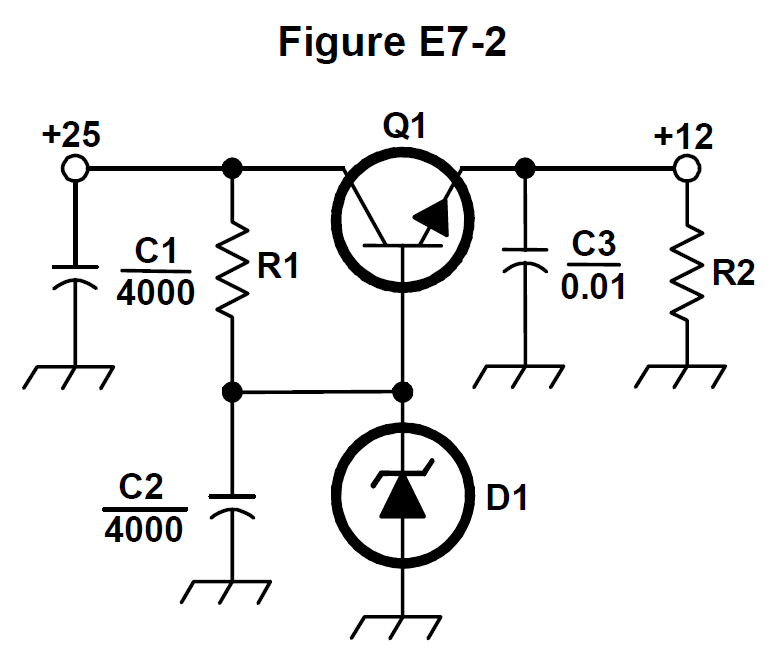
-
A
It provides negative feedback to improve regulation
-
B
It provides a constant load for the voltage source
-
C
It controls the current to keep the output voltage constant
-
D
It provides regulation by switching or "chopping" the input DC voltage
E7D07
What is the purpose of C2 in the circuit shown in Figure E7-2?
-
A
It bypasses rectifier output ripple around D1
-
B
It is a brute force filter for the output
-
C
To prevent self-oscillation
-
D
To provide fixed DC bias for Q1
E7D08
What type of circuit is shown in Figure E7-2?
-
A
Switching voltage regulator
-
B
Common emitter amplifier
-
C
Linear voltage regulator
-
D
Common base amplifier
E7D09
How is battery operating time calculated?
-
A
Average current divided by capacity in amp-hours
-
B
Average current divided by internal resistance
-
C
Capacity in amp-hours divided by average current
-
D
Internal resistance divided by average current
E7D10
Why is a switching type power supply less expensive and lighter than an equivalent linear power supply?
-
A
The inverter design does not require an output filter circuit
-
B
The control circuitry uses less current, therefore smaller heat sinks are required
-
C
The high frequency inverter design uses much smaller transformers and filter components for an equivalent power output
-
D
It recovers power from the unused portion of the AC cycle, thus using fewer components
E7D11
What is the purpose of an inverter connected to a solar panel output?
-
A
Reduce AC ripple on the output
-
B
Maintain voltage with varying illumination levels
-
C
Prevent discharge when panel is not illuminated
-
D
Convert the panel's output from DC to AC
E7D12
What is the dropout voltage of a linear voltage regulator?
-
A
Minimum input voltage for rated power dissipation
-
B
Maximum output voltage drop when the input voltage is varied over its specified range
-
C
Minimum input-to-output voltage required to maintain regulation
-
D
Maximum that the output voltage may decrease at rated load
E7D13
Which of the following calculates power dissipated by a series linear voltage regulator?
-
A
Input voltage multiplied by input current
-
B
Input voltage divided by output current
-
C
Voltage difference from input to output multiplied by output current
-
D
Output voltage multiplied by output current
E7D14
What is the purpose of connecting equal-value resistors across power supply filter capacitors connected in series?
-
A
Equalize the voltage across each capacitor
-
B
Discharge the capacitors when voltage is removed
-
C
Provide a minimum load on the supply
-
D
All these choices are correct
E7D15
What is the purpose of a step-start circuit in a high-voltage power supply?
-
A
To provide a dual-voltage output for reduced power applications
-
B
To compensate for variations of the incoming line voltage
-
C
To prevent arcing across the input power switch or relay contacts
-
D
To allow the filter capacitors to charge gradually