Study › Technician › T6D

T6D

ELECTRONIC AND ELECTRICAL COMPONENTS

Component functions: rectifiers, relays, voltage regulators, meters, indicators, integrated circuits, transformers; Resonant circuit; Shielding

Drill results are kept in this browser. Log in to keep them on your account and get a study plan.

T6D011 of 11

Which of the following devices or circuits changes an alternating current into a varying direct current signal?

Why A rectifier uses diodes, which conduct in only one direction, to block or flip the negative half of an AC waveform so the output current always flows the same way. The result is pulsating (varying) DC, which a filter capacitor then smooths into steady DC in a power supply. That one-way conduction is exactly what the word 'rectify' means here.
Watch out A transformer is tempting because it sits right next to the rectifier in a power supply, but it only steps AC voltage up or down through magnetic coupling; its output is still AC.
Diode = one-way street. Rectify means 'make it go one way' -> AC in, pulsating DC out.
HamSandwich explanation, first draft. The question and answers are the NCVEC text.
T6D022 of 11

What is a relay?

Why A relay is a switch whose contacts are opened or closed by an electromagnet: current through the coil pulls an armature that moves the contacts. That lets a small control current (from a low-power circuit, a keying line, or a microcontroller) switch a much larger or completely isolated circuit, such as an antenna changeover or an amplifier's AC power. The coil and contacts are electrically separate, which also gives useful isolation between control and switched circuits.
Watch out The amplifier choices describe active devices like transistors; a relay has no gain and only makes or breaks a connection. A pass transistor is the series element in a voltage regulator, not a switch controlled by a coil.
Relay = coil pulls contacts. Small current in, big circuit switched. It switches, it does not amplify.
HamSandwich explanation, first draft. The question and answers are the NCVEC text.
T6D033 of 11

Which of the following is a reason to use shielded wire?

Why Shielded wire has a grounded conductive braid or foil wrapped around the inner conductor. That shield intercepts electric fields, so stray RF or noise outside the cable cannot induce signals on the center conductor, and signals carried inside the cable cannot radiate out. That is why audio leads, microphone cables, and coaxial feedlines are shielded.
Watch out Reducing receiver overload is tempting because shielding does help keep interference out, but overload is a front-end problem usually fixed with filters or attenuators, not a property of the wire. Shielding does not change the conductor's resistance or its current rating, since those depend on the center conductor's size and material.
Shield = a fence around the wire: keeps signals in, keeps noise out.
HamSandwich explanation, first draft. The question and answers are the NCVEC text.
T6D044 of 11

Which of the following displays an electrical quantity as a numeric value?

Why A meter is the component whose whole purpose is to indicate the value of an electrical quantity such as voltage, current, or resistance, either with a moving pointer on a scale or as digits on a display. Multimeters, ammeters, and voltmeters all fall into this category. The other parts listed control or switch current rather than report it.
Watch out A potentiometer is tempting because it has a knob and a scale printed around it, but it is a variable resistor that adjusts a circuit, it does not measure or display anything.
Meter = measure. If the question asks what shows a number or reading, the answer is the meter.
HamSandwich explanation, first draft. The question and answers are the NCVEC text.
T6D055 of 11

What type of circuit controls the amount of voltage from a power supply?

Why A voltage regulator is the stage in a power supply that holds the output voltage at a set value despite changes in input voltage or load current. Common examples are Zener diode shunt regulators and three-terminal ICs like the 7805, which delivers a steady 5 V. Without regulation, the DC output would sag as more current is drawn and rise as the AC line voltage climbs.
Watch out A filter is tempting because it also follows the rectifier, but it only smooths ripple into steadier DC; it does not set or hold the voltage level. An oscillator generates AC signals, and a phase inverter reverses signal polarity.
Regulator regulates the volts; filter just smooths the ripple.
HamSandwich explanation, first draft. The question and answers are the NCVEC text.
T6D066 of 11

What component changes 120 V AC power to a lower AC voltage for other uses?

Why A transformer uses two coils sharing a magnetic core, so AC in the primary induces a voltage in the secondary. The output voltage follows the turns ratio: fewer turns on the secondary than the primary gives a lower AC voltage, which is exactly what a step-down power supply transformer does with 120 V AC line power. Note that the output is still AC; nothing here converts it to DC.
Watch out A diode is tempting because it appears in every power supply, but it rectifies AC into pulsating DC rather than lowering an AC voltage. Capacitors and transistors do not change AC line voltage levels this way.
AC in, AC out at a new voltage means transformer. Change AC to DC means diode/rectifier.
HamSandwich explanation, first draft. The question and answers are the NCVEC text.
T6D077 of 11

Which of the following is commonly used as a visual indicator?

Why An LED (light emitting diode) is a semiconductor diode that emits light when forward current passes through it, so it is the standard low-power visual indicator on radios, power supplies and panels. It needs only a few milliamps and typically drops about 1.5 to 3 volts depending on color, so it is usually driven through a series current-limiting resistor.
Watch out A FET is an amplifying or switching transistor, and a Zener diode is used in reverse bias to hold a steady reference voltage. Neither produces light, so 'all these choices' fails.
LED = Light Emitting Diode. The only one of the three that lights up.
HamSandwich explanation, first draft. The question and answers are the NCVEC text.
T6D088 of 11

Which of the following is combined with an inductor to make a resonant circuit?

Why A resonant (tuned) circuit needs two energy storage elements that react oppositely: an inductor stores energy in a magnetic field and a capacitor stores it in an electric field. At one frequency their opposing reactances are equal and cancel, giving resonance at f = 1/(2π√LC). That LC pair is the heart of filters, tuners, traps and oscillator tank circuits.
Watch out A resistor is the tempting pick because it is the other basic passive part, but resistance only dissipates energy and damps the circuit, it does not store energy or create resonance; it just broadens the response and lowers Q.
Resonance takes L and C: the two parts that store energy. Remember f = 1/(2π√LC).
HamSandwich explanation, first draft. The question and answers are the NCVEC text.
T6D099 of 11

What is the name of a device that combines several semiconductors and other components into one package?

Why An integrated circuit, or IC, is a single package containing many transistors, diodes, resistors and other elements fabricated together on one chip of semiconductor material. That is what lets a whole amplifier, logic gate array or microprocessor fit in one small part. Common ham radio examples include op-amps, voltage regulators and microcontrollers.
Watch out A transformer is just coupled coils of wire with no semiconductors, and a transducer is any device that converts one form of energy to another, such as a microphone or speaker.
Integrated means many parts integrated into one chip.
HamSandwich explanation, first draft. The question and answers are the NCVEC text.
T6D1010 of 11

What is the function of component 2 in figure T-1?
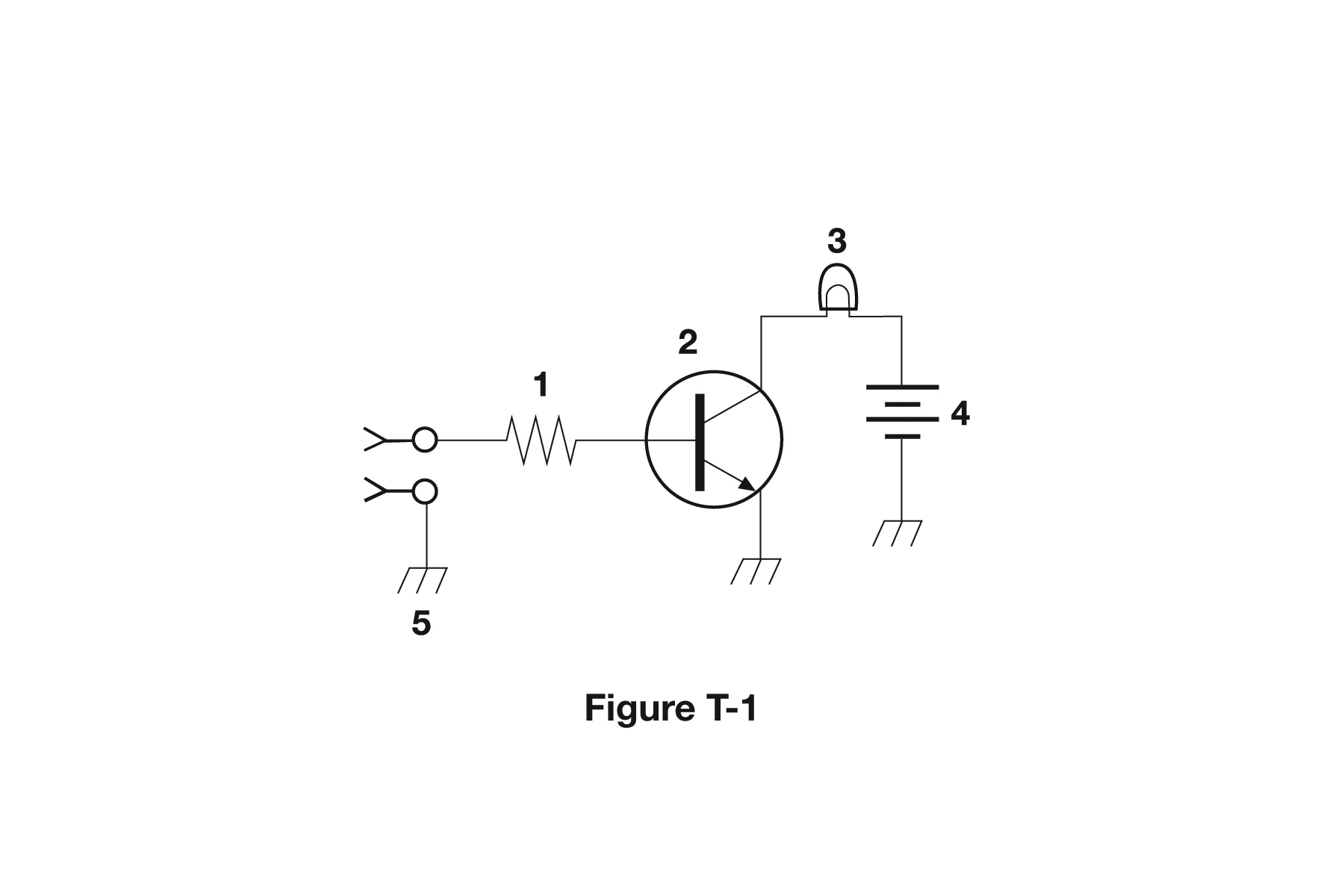
Figure T-1 from the NCVEC question pool
Why Component 2 in Figure T-1 is the transistor, drawn as a circle with an arrow on one lead (the emitter) plus a base and collector. A transistor is an active device in which a small base current or voltage controls a much larger current flowing between collector and emitter, so it works as an amplifier or an electronic switch. That makes controlling the flow of current its basic function.
Watch out The other choices describe the other parts in the same figure: the lamp gives off light, the battery supplies energy, and the antenna turns electrical energy into radio waves.
Transistor = 'transfer resistor': a tiny base signal controls a big current. Circle with an arrow on one lead.
HamSandwich explanation, first draft. The question and answers are the NCVEC text.
T6D1111 of 11

Which of the following is a resonant or tuned circuit?

Why A resonant (tuned) circuit is formed by an inductor and a capacitor together, either in series or in parallel. Energy sloshes back and forth between the magnetic field of the coil and the electric field of the capacitor, and at one particular frequency the inductive and capacitive reactances are equal and cancel. That resonant frequency is f = 1 / (2 x pi x square root of LC), which is why LC combinations are used to set frequency in filters, oscillators and antenna tuners.
Watch out A linear voltage regulator only holds a DC output steady, and a resistor network can absorb power but cannot store and exchange energy the way L and C do, so neither is frequency selective.
Tuned = L + C. Resistors dissipate, but only inductance and capacitance resonate.
HamSandwich explanation, first draft. The question and answers are the NCVEC text.
Yaesu FT-65R VHF/UHF Dual Band HandheldSponsored · View on Amazon →ARRL Ham Radio License ManualSponsored · View on Amazon →
← T6C All groups T7A →